
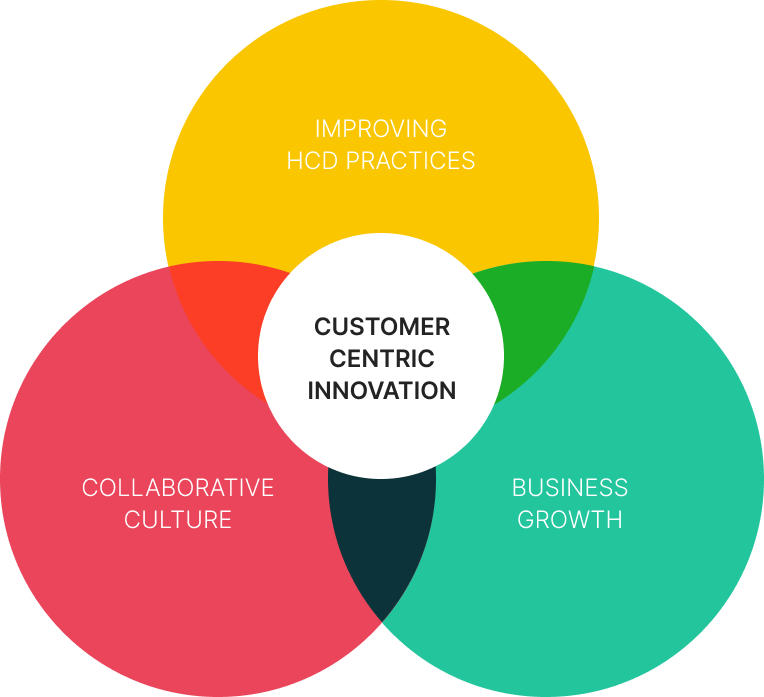
Scaling Human-Centered Design
Role: Director of Design Practices | Design Research & Operations
Duration: Initial assessment and impact delivered within ~3 months, with ongoing work extending across multiple quarters.
I led the Design Practice Service within Capital One’s Research and Design Operations organization, focusing on how human-centered design was being practiced across teams operating at different levels of collaboration, ownership, and execution maturity.
As teams scaled across the organization, experience quality and design practices had become increasingly inconsistent. The work focused on identifying patterns affecting collaboration, execution, and adoption in order to create a clearer understanding of where teams were succeeding and where friction existed.
Key Outcomes
Established a consistent scalable HCD assessment framework to evaluate how teams were practicing human-centered design across 22 critical business experiences
Shifted design quality conversations from perception to evidence through structured evaluation
Identified systemic gaps in collaboration, ownership, and execution across teams
Enabled more than 50% of participating teams to identify and prioritize operational and collaboration improvements
Achieved 82% satisfaction with the HCD review process
Created a foundation for improving design maturity and informing future investment
Challenge
Capital One had made a strong investment in human-centered design, supported across design, product, and engineering.
However, execution varied significantly across teams.
Teams interpreted HCD practices differently
Ownership across design and product was unclear
Collaboration models were inconsistent
Teams were often solving similar problems in different ways, creating uneven approaches to collaboration, delivery, and experience quality across the organization.
Even among top-priority business experiences, outcomes were uneven. The opportunity wasn’t to introduce design, but to make it work consistently at scale.
Approach
1. Understand How Teams Were Actually Operating
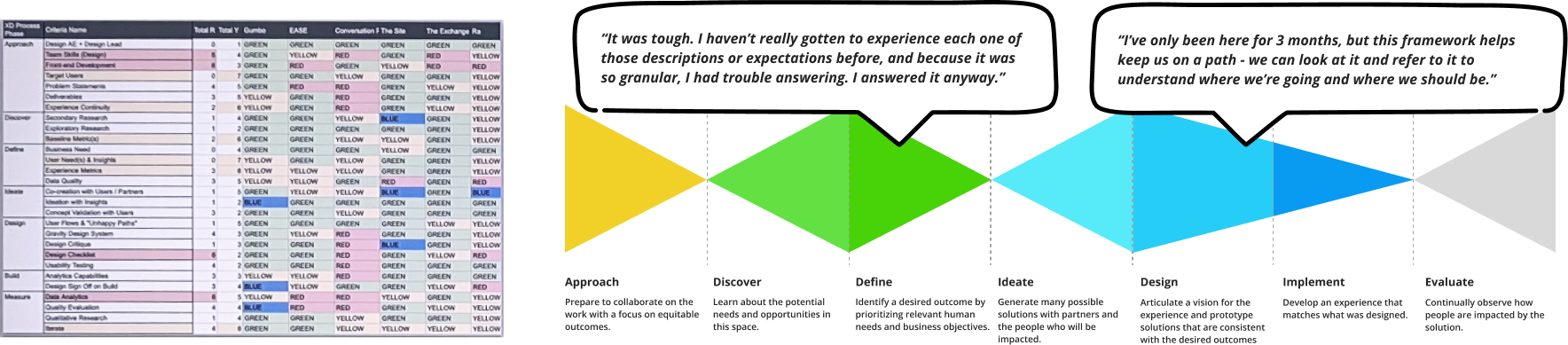
Partnered with executive design leaders to identify 22 key business experiences and conducted structured HCD assessments to understand how teams were actually operating.
This created a shared, evidence-based view of design performance across the organization.
2. Create a More Consistent Way to Evaluate Practices
Led the refinement of an HCD scorecard that:
Evaluated teams across each phase of the design process
Defined clearer criteria for assessing execution
Enabled more consistent evaluation across teams
Was designed to be reusable by teams over time
It provided a consistent way for teams to assess and strengthen their design practices over time.
3. Look Beyond Deliverables to Understand Team Dynamics
Through assessments and team interviews, we identified that performance differences were driven less by design capability and more by how teams operated.
Common patterns emerged:
Lower-performing teams
Hierarchical decision-making
Limited collaboration across functions
Focus on MVP delivery over experience quality
Higher-performing teams
Shared ownership across design, product, and engineering
Strong alignment and communication
Integrated decision-making throughout the process
This reframed the problem from a design issue to a systems and collaboration issue.
4. Create Shared Understanding With Leadership
To move beyond assessment, I worked directly with executive design leaders across lines of business.
Conducted individual sessions to align on findings and priorities
Connected HCD improvements to business and product outcomes
Introduced a roadmap for scaling practices across the organization
This included:
A Product Delivery Blueprint to clarify roles and responsibilities
Expanded HCD resources and training
A plan for ongoing assessment and continuous improvement
Results
Immediate Impact (within 3 months)
82% of teams rated the HCD reviews as helpful
76% found the insights valuable
Over 50% of participating teams implemented operational or collaboration improvements based on assessment findings
Organizational Impact
Established a more consistent understanding of how teams evaluated and applied human-centered design practices
Exposed recurring gaps in collaboration, ownership, and execution across teams
Highlighted and began addressing misalignment between design, product, and engineering
Created a more structured and repeatable approach for teams to evaluate and improve their practices over time
Strategic Impact
Introduced a repeatable approach for assessing human-centered design practices across teams
Shifted design toward more consistent and measurable evaluation criteria into how teams reviewed design practices
Increased visibility into how collaboration and operational practices were affecting experience quality across teams
Established a foundation for continued improvement in design maturity and team practices
Key Takeaways
Scaling design practices requires more than standards alone
Collaboration patterns often have a direct impact on execution quality
Sustained adoption depends heavily on leadership alignment and support
Simplicity and clarity drive adoption more effectively than process complexity
What I’d Do Differently
Engage leadership earlier and more consistently across design, product, and business teams
Begin with teams more open to change in order to demonstrate early momentum
Further simplify and adapt the HCD framework to better reflect how teams actually work
Invest earlier in structured training, enablement, and ongoing support
Because ultimately:
“Long-term progress depends less on defining the “right” process and more on creating alignment, encouraging adoption, and reinforcing sustainable behavior change”
Want to learn more? Get in touch